Bay Parking
The reference points for reverse and forward bay parking, with diagrams: where to stop, when to steer and when to straighten, for bays on your left and your right.
4
Methods
Medium
Difficulty
Left & Right
Bays Covered
Both
Directions Tested
Watch the Method
Bay Parking Reference Points
A reference point is a part of the car you line up with a bay line, so you turn in the same place every time. These are the points we start pupils on. They are a starting point, not a rule: your instructor will fine tune them for the car you learn in.
Reverse bay parking
- Distance
- About a car’s width out from the ends of the bays
- Stop
- Door on the bay side level with the second line past your bay
- Steer
- Full lock towards the bay, reversing slowly
- Straighten
- When both bay lines look parallel in your door mirrors
Forward bay parking
- Distance
- Keep wide, towards the far side of the aisle
- Steer
- Full lock as your door mirror comes up to the first line of the bay
- Watch
- Your rear wheel cutting in towards the next car
- Leave
- Reverse straight out until your front is clear, then steer
Reverse bay parking, bay on your left
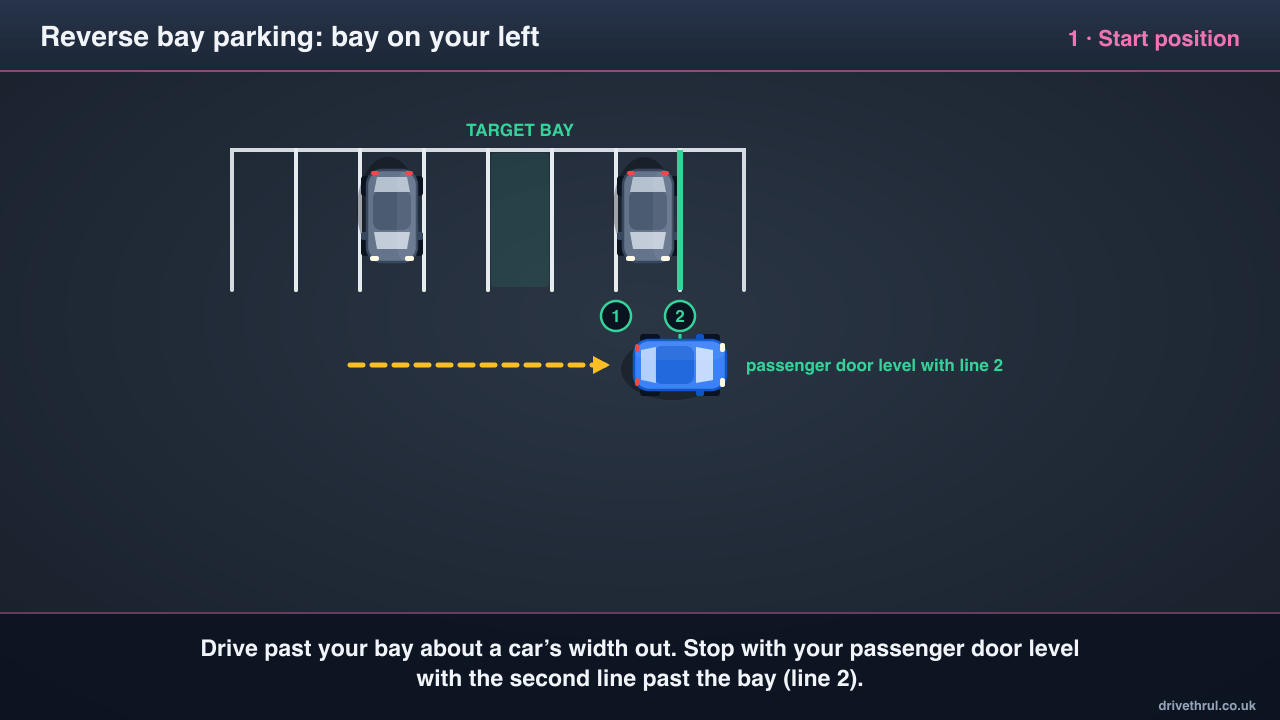
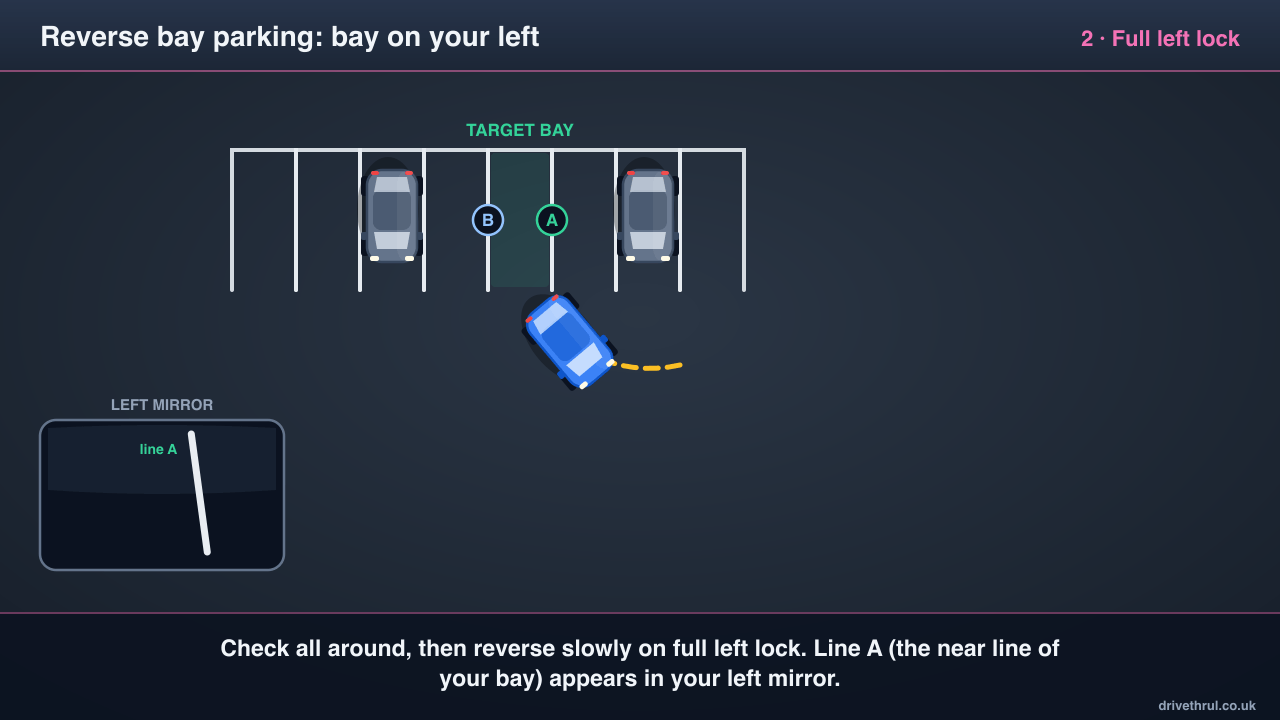
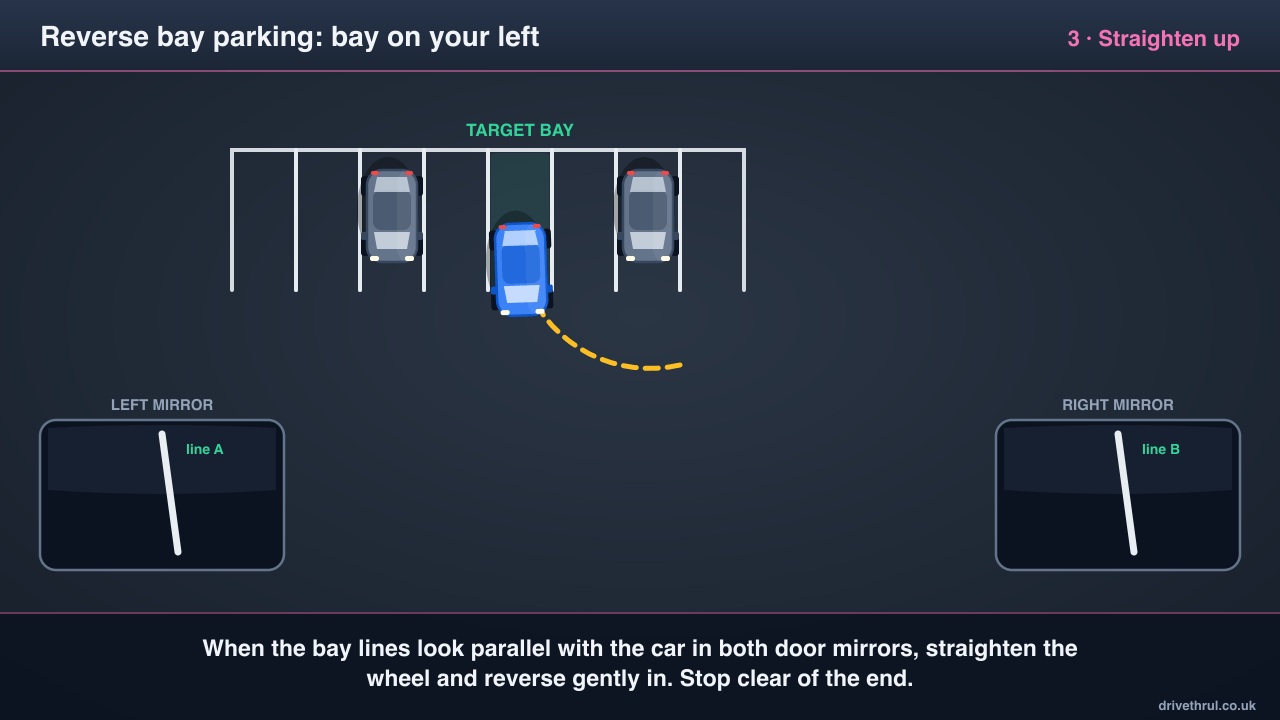
Bay on your right? Mirror everything: stop with your own door (roughly your shoulder) level with the second line past the bay, check your left blind spot last, and reverse on full right lock. Most learners find the right side easier because they can see the bay through their own window.
Forward bay parking
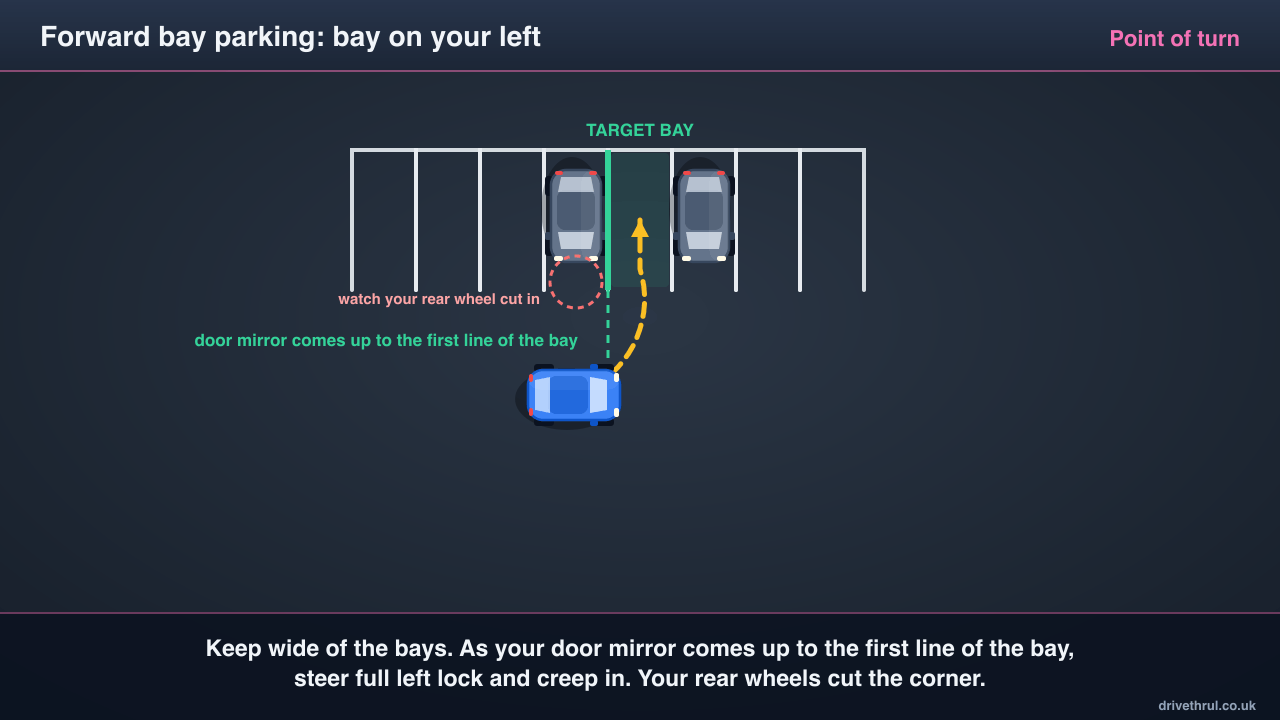
Why your reference point might be different
The point mostly depends on how tightly the car turns. A small car that turns tightly needs to start the turn a little sooner; a bigger car, a little later. Where you sit changes how the lines line up with your door and mirrors too, so set your seat the same way every time. Use one point, see where you finish, and adjust from there.
Step by Step: All Four Ways
Reverse bay parking (left): reverse in, then drive out forwards later. Driving out forwards gives you a much better view of the aisle when you leave.
Pick Your Bay and Get Your Distance
Drive slowly along the aisle with the bays on your left, about a car’s width out from the ends of the bays. Pick your bay early, ideally one with space either side while you are learning.
Stop at the Reference Point
Count the lines after your bay as you pass it: the first line past it is line 1, the next is line 2. Stop with the centre of your passenger door level with line 2.
Observe and Select Reverse
Select reverse, then look all around: mirrors, both blind spots and out of the rear window. Check your right blind spot last, because the front of the car swings out to the right as you turn.
Reverse Slowly on Full Left Lock
Creep back and turn the wheel briskly to full left lock. Keep the car slow and keep looking all around, not just in the mirrors. The near line of the bay (line A) appears in your left door mirror first.
Straighten When the Lines Are Parallel
Soon the far line of the bay (line B) appears in your right mirror. When both lines look parallel with the car, take the lock off so the wheels are straight, then reverse gently into the bay.
Stop Clear of the End and Secure
Stop with the whole car inside the bay and clear of the kerb, wall or line behind. Handbrake on, neutral (or Park in an automatic).
Observation Checklist
Common Mistakes & How to Fix Them
Turning too early or too late
Stop at the same reference point every time. If you finish on the side you came from, stop a little earlier next time; too far the other way, go a little further past.
Only watching the mirrors
Mirrors show the lines, not the person walking behind the car. Keep looking all around, including over your shoulder and out of the rear window, throughout.
Ending up crooked
Compare the gap to each line in the two door mirrors. If you are angled, stop, pull forward a little to straighten, and reverse in again. Do not try to fix a bad angle while reversing.
Going too fast
Slow speed gives you time to steer and to see. Use clutch control in a manual, or creep with gentle brake in an automatic.
Clipping the next car on a forward bay
The rear wheels cut inside the front. Keep wide before you turn and watch the corner of the car on the bay side.
Rushing the exit
When leaving a bay, especially reversing out, look all around before moving and again as you go. Cars and people appear quickly in car parks.
What the Examiner Looks For
This comes from the guidance DVSA publishes for its own examiners. Bay parking is marked on two things, control and observation, and the examiner judges where you finish rather than how pretty the way in was.
Control
Smooth, slow and accurate. DVSA lists having to reposition the car a lot, touching the kerb, and not finishing within the marked bay as faults.
Observation
Effective all-round observation throughout, marked even if no one is about and judged as if you were on the road. Reversing out of a bay is where observations are most often missed.
Final position
Inside the bay, reasonably straight, somewhere the car could sensibly be left. Crossing a line on the way in is not normally penalised; finishing outside the bay is.
Your choice of bay
The examiner will not pick the bay or tell you how to do it. Choose any convenient empty bay; cars either side are fine if they are inside their own lines.
When it happens: reversing into a bay is done in the test centre car park at the start or end of the test. At the start you will usually drive out of a bay, stop with the wheels straight, then reverse into a convenient bay. Driving in and reversing out is done in a car park along your route.
Sources: DVSA, Carrying out driving tests: examiner guidance and Understanding your driving test result.
Bay Parking Test Tips
Choose your bay well
You pick the bay, so pick a good one: ideally with space on at least one side, away from people loading cars.
Count the lines first
Before you stop, count the lines past your bay so you know exactly where your reference point is.
Creep, do not roll
Slower than walking pace. Clutch control in a manual, gentle brake in an automatic. Slow speed is what makes the reference points work.
Look, then move
All-round checks before every movement, and keep looking while you move. If someone walks behind, stop and wait for them.
Correct once, calmly
If you are off, stop, look all around, pull forward a little and go back in. One tidy correction beats several small shunts.
Finish properly
Handbrake on and neutral (or Park). If the examiner wants to check your position from outside, they will ask you to secure the car and switch off.
Practise in different car parks
DVSA suggests it: bays, lines and space vary, and test day will not look exactly like your usual car park.
Same seat, same mirrors
Set your seat and mirrors the same way every time, or your reference points move.
Bay Parking FAQs
For a bay on your left, drive past it about a car’s width out and stop with the centre of your passenger door level with the second line past the bay. Check all around, then reverse slowly on full left lock. When both bay lines look parallel with the car in your door mirrors, straighten the wheel and reverse gently into the bay. For a bay on your right, do the same with your own door level with the second line, and full right lock.
Keep wide of the bays. As your door mirror on the bay side comes up to the first line of the bay, steer full lock towards it and creep forward. Straighten as the car comes into line with the bay, then stop before the end line or kerb.
Reference points depend mostly on the car. A car that turns tightly needs to start the turn a little sooner, a bigger car a little later. Your seat position also changes how the lines line up with your door and mirrors. If you keep finishing on the side you came from, stop a little earlier next time; if you finish too far the other way, go a little further past. Your instructor will set the points for the car you learn in.
Either. DVSA says you may be asked to park in a bay by driving in and reversing out, or by reversing in and driving out, and the examiner will tell you which. Bay parking is one of the reversing exercises, with parallel parking and pulling up on the right. You will only be asked to do one, so practise them all.
No. DVSA tells examiners not to choose the bay or say how to do the manoeuvre. You pick any convenient empty bay, and it is fine if there are cars either side, as long as they are not over the lines into your bay. Pick one you are comfortable with.
Reversing into a bay is done in the test centre car park, either at the start of the test or at the end. At the start you will usually drive out of a bay, stop with the wheels straight, then reverse into a convenient bay. Driving into a bay and reversing out is done in a car park along your route, and the examiner may tell you which way to reverse out.
Not normally. DVSA guidance says candidates should not normally be penalised for crossing the lines while entering the bay. What matters is where you finish: inside the bay, in a position the car could reasonably be left. Finishing outside the bay is not acceptable.
Yes. Examiners mark your observations whether or not anyone is there, and judge them as if you were on the road. Look all around before you move and keep looking while the car is moving, especially when reversing out of a bay.
Yes. If the angle is wrong, stop, check all around, pull forward a little to straighten, then reverse in again. A controlled correction with good observation is fine. DVSA lists having to reposition the car a lot, because of poor control, as a fault, so aim to correct once rather than many times.
No. You need to finish within the lines and reasonably straight. DVSA tells examiners not to be too concerned about exactly where in the bay you end up. Finishing over a line, or clearly at an angle, can be marked as a fault.
Stop and let them pass, then check all around again before you carry on. The examiner wants to see you look all around throughout the manoeuvre and respond to people and cars, not just watch your mirrors.
No. The points are the same. In an automatic you control the speed with gentle brake pressure instead of clutch control, so keep your foot covering the brake and let the car creep.
Want to Practise Bay Parking?
Our instructors will take you to a quiet car park and walk you through every step.