Bay parking is one of the reversing manoeuvres you may be asked to perform during your UK driving test. Whether you need to reverse into a bay and drive out forwards, or drive in forwards and reverse out, this guide will give you the confidence to complete both variations safely and accurately.
Test Manoeuvre
Bay parking is one of three possible reversing manoeuvres on the driving test. You will only be asked to do one manoeuvre, but you should be prepared for any of them.
📋 Two Types of Bay Parking
There are two types of bay parking you need to understand. The examiner will tell you which one to perform during your test.
Reverse Bay Parking
Reverse into the bay, then drive out forwards.
- ✔ Better visibility when leaving
- ✔ More control with slow speed
- ✔ Easier to adjust position
- ✔ Easier to leave safely
Forward Bay Parking
Drive forwards into the bay, then reverse out.
- ✔ Quick and straightforward entry
- ✔ Good for busy car parks
- ✔ Requires careful reversing out
- ✔ Watch your rear wheels cut in
🎯 When Is Bay Parking Used on the Test?
During your driving test, bay parking is one of three possible reversing manoeuvres. The examiner will tell you which one to do:
Parallel Parking
Park behind another vehicle at the kerb
Bay Parking
Park in a marked bay (forward or reverse)
Pull Up on Right
Pull up on the right and reverse back
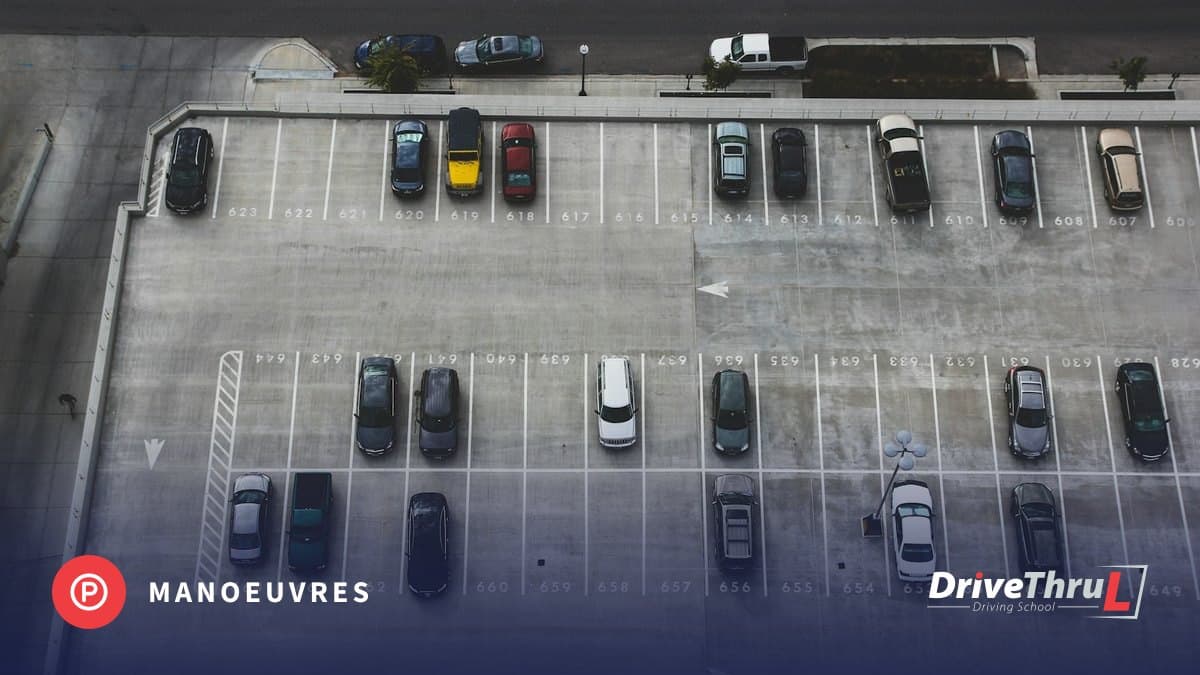
Bay parking typically takes place either at the test centre car park (at the start or end of your test) or at a suitable location during your test route, such as a supermarket car park.
Important Note
The examiner will clearly tell you which type of bay parking to perform. Listen carefully to the instructions before you begin.
🔎 Key Reference Points for Bay Parking
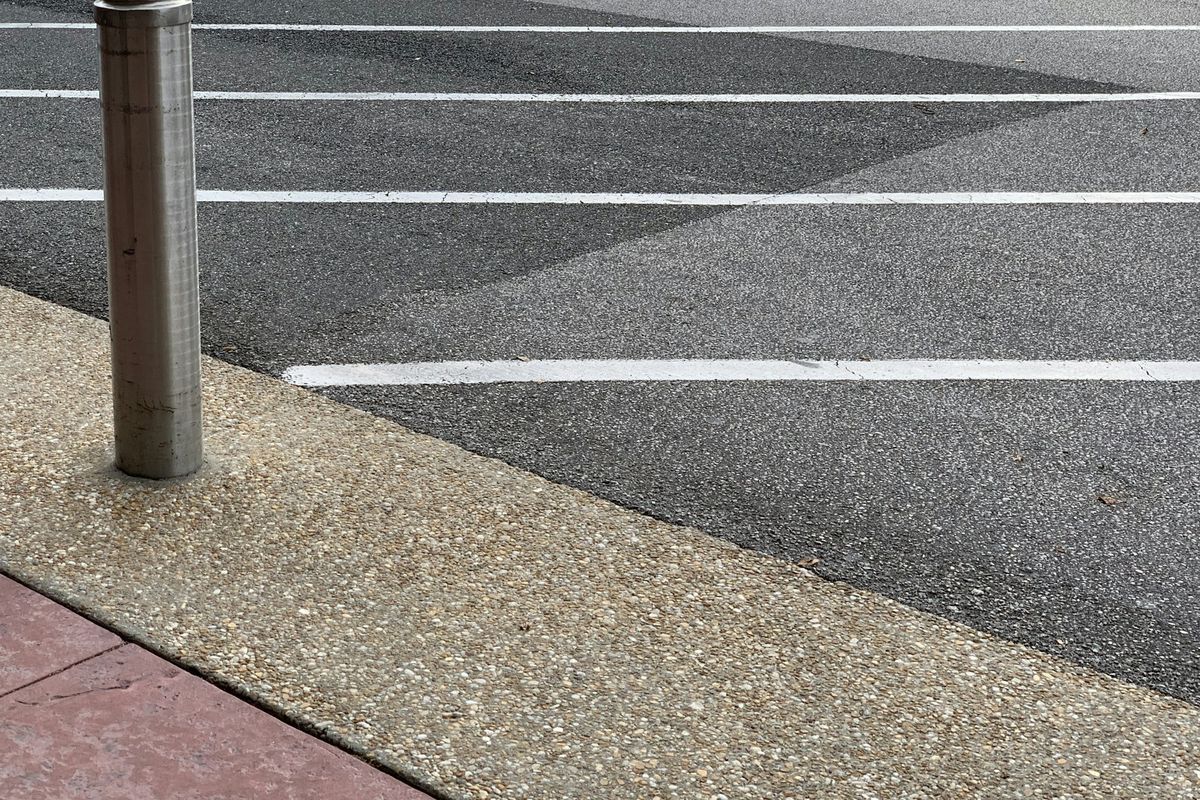
Reference points help you turn in the same place every time. These are the points we start pupils on; you may need to adjust them slightly for your car, mostly because cars turn more or less tightly. There are step by step diagrams of each one on our bay parking reference points page.
📍 Essential Reference Points
Reverse: Door on Line 2
Bay on your left: stop with your passenger door level with the second line past the bay, then reverse on full left lock. Bay on your right: use your own door.
Forward: Mirror on Line 1
Keep wide, then steer full lock as your door mirror comes up to the first line of the bay
Straighten: Lines Parallel
When the bay lines look parallel with the car in both door mirrors, take the lock off
Front Stopping Point
Stop before your bonnet reaches the bay line or obstacle ahead
🔄 Step by Step: Reverse Bay Parking
Reversing in means you drive out forwards later, with a much better view of the aisle. Here is the process for a bay on your left; for a bay on your right, swap left and right and use your own door as the reference.
Find Your Target Bay
Choose a bay with empty spaces on either side if possible. This gives you more room for error and makes observations easier.
Position Your Car
Drive slowly past your target bay about a car's width out from the ends of the bays. Count the lines after the bay: line 1, then line 2. Stop with the centre of your passenger door level with line 2.
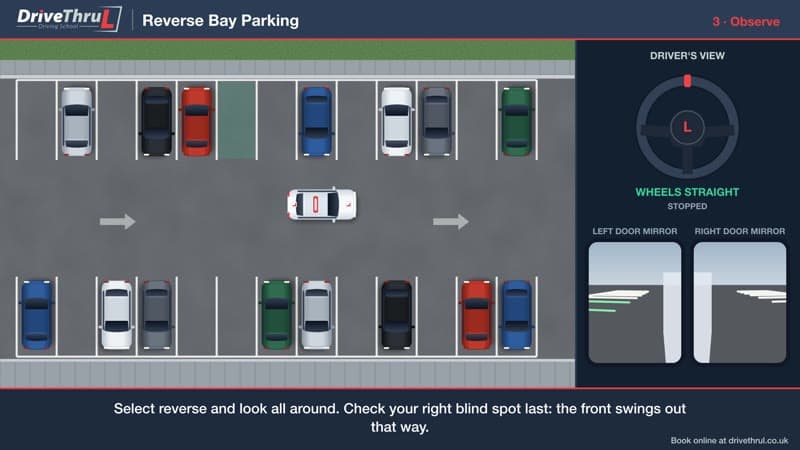
Select Reverse and Observe
Select reverse gear. Check all mirrors and both blind spots, and look out of the rear window. Check your right blind spot last: the front of the car swings out to the right as you turn.
Begin Reversing Slowly
Use clutch control (or gentle brake in automatic) to creep back. Keep your speed slower than walking pace, and keep looking all around, not just in the mirrors.
Full Lock Towards the Bay
As the car starts to move, turn the wheel briskly to full left lock. The near line of the bay appears in your left door mirror, then the far line in your right mirror. Continue to check all around as you turn.
Check Both Mirrors
As the car enters the bay, look in both wing mirrors. You want to see the bay lines equally in each mirror. If one side has more space, adjust your steering accordingly.
Straighten Up
When the car is straight in the bay (lines look equal in both mirrors), straighten the steering wheel. Continue reversing slowly until you are fully in the bay.
Stop and Secure
Stop before reaching any kerb or obstacle behind. Apply the handbrake and select neutral (or Park in automatic). You have completed the manoeuvre.
→ Step by Step: Forward Bay Parking
Forward bay parking is quick going in, but your view is limited when you reverse out, so that part needs the most care. Here is how to do it:
Identify Your Bay
Choose a bay with space on both sides if available. This makes the manoeuvre easier and gives room for adjustment.
Keep Wide
Keep towards the far side of the aisle so there is room to swing the front of the car into the bay. Being too close to the bays makes the turn tight.
Check Mirrors and Blind Spots
Before turning, check your mirrors and the side you are turning towards. Look for pedestrians, trolleys, and other vehicles.
Turn Into the Bay
As your door mirror on the bay side comes up to the first line of your bay, steer full lock towards it and creep in. Your rear wheels cut inside the front, so watch the corner of the car parked on that side.
Straighten and Centre
As your car enters the bay, straighten the steering. Use your wing mirrors to check you are centred between the lines.
Stop Before the End
Stop well before reaching the kerb or any obstacle ahead. Leave enough room to open your door if needed.
🚗 Driving Out of a Bay
How you leave the bay depends on how you entered. Both require excellent observation.
✔ After Reverse Bay Parking
Driving forwards out:
- Check all mirrors and blind spots
- Look for pedestrians walking past
- Move forward slowly
- When bonnet clears adjacent cars, check again
- Turn steering as needed and exit
✔ After Forward Bay Parking
Reversing out:
- Check all mirrors and behind you thoroughly
- Reverse very slowly, looking all around
- Keep checking as you emerge
- When rear clears adjacent cars, check mirrors
- Continue until safe to turn and exit forwards
Reversing Out: Key Warning
When reversing out of a bay, you have very limited visibility. Move extremely slowly and be prepared to stop immediately if you see or hear anyone. Car parks have unpredictable pedestrian movement.
❌ Common Mistakes and How to Avoid Them
Understanding common errors helps you avoid them. Here are the most frequent mistakes learners make with bay parking:
Mistake: Starting Too Close to the Bays
If you are too close, you will not have enough turning room.
✔ Fix: Position at least 1 metre away from the bays before reversing.
Mistake: Turning Too Early or Too Late
This results in being crooked or hitting the kerb.
✔ Fix: Use your reference points consistently and adjust based on experience.
Mistake: Moving Too Fast
Speed makes it harder to observe and correct mistakes.
✔ Fix: Keep your speed at walking pace or slower. You can always speed up later.
Mistake: Poor Observation
Not checking around frequently can result in a serious fault.
✔ Fix: Keep your head moving. Check mirrors, blind spots, and all around continuously.
Mistake: Not Adjusting When Off-Centre
Finishing crooked or too close to one side.
✔ Fix: If you are not centred, pull forward and reverse again to adjust. This is allowed on the test.
🔍 What Examiners Look For
Understanding the examiner's perspective helps you focus on what matters. DVSA marks bay parking on control and observation. Its guidance for examiners also says you choose the bay yourself, that crossing a line on the way in is not normally penalised, and that what counts is finishing inside the bay. There is more on our what the examiner looks for section. Here is what they assess:
✔ Pass Criteria
- ✔ Effective all round observation
- ✔ Reasonable accuracy (within the bay)
- ✔ Good control at slow speed
- ✔ Safe response to other road users
- ✔ Appropriate use of corrections
- ✔ All-round checks even when the car park is empty
❌ Faults That Can Become Serious
- ❌ Failing to observe properly
- ❌ Finishing well outside the bay
- ❌ Hitting a kerb, car or obstacle
- ❌ Causing danger to others
"Examiners understand that manoeuvres can be tricky. They are not looking for perfection. They want to see that you can control the car safely, observe properly, and make sensible corrections when needed."
👤 DriveThruL Instructor Team
💡 Practice Tips for Bay Parking
Consistent practice is key to mastering bay parking. Here are our top tips:
🌟 Top Practice Tips
Start in Empty Car Parks
Supermarket car parks early morning or late evening are perfect
Practice Both Sides
Get comfortable reversing into bays on your left and right
Try Different Bay Sizes
Bays vary in width. Practice in narrow and wide bays
Practice Between Cars
Once confident, practice with parked cars next to your target bay
Note Your Reference Points
Every car is different. Find what works for your vehicle
Same Seat, Same Points
Set your seat the same way every time, or your reference points will move
📝 Quick Summary
Reverse Bay Parking
- ✔ About a car's width out from the bays
- ✔ Full observation before moving
- ✔ Door level with line 2, then full lock
- ✔ Straighten when lines look parallel
- ✔ Reverse in, stop clear of the end
Forward Bay Parking
- ✔ Keep wide of the bays
- ✔ Check mirrors and blind spots
- ✔ Full lock as mirror nears line 1
- ✔ Straighten and drive in
- ✔ Extra care reversing out
🎯
Master Bay Parking with Expert Instruction
Our DVSA approved instructors in East London will help you perfect bay parking and all other test manoeuvres.
Book a Lesson Today →