Dual CarriagewaysJoining, Merging and Lane Discipline
Nothing on a dual carriageway is harder than what you already do. It just happens faster, so every decision has to be made earlier. This page covers joining, reading the lane signs, merging, and getting off again.
What Actually Changes at 70mph
A dual carriageway is any road where the two directions of traffic are separated by a central reservation. It is not a motorway. Learners are allowed on them from day one, and roads like the A12, A13 and A406 are part of everyday driving in East London. The skills are the same ones you use in town. The difference is that a gap you would have taken your time over now closes in a couple of seconds.
Look Further Ahead
Your eyes need to be where the car will be in fifteen seconds, not where the bonnet is now.
Decide Earlier
Mirrors, signal and position all move forward. Late decisions are what make these roads feel frightening.
Match the Traffic
Being too slow is as much of a hazard as being too fast, especially when you are joining.
Reading the Lane Arrangement Signs
These signs are the ones learners find most unsettling, because several of them look almost identical at a glance. They are worth learning properly, because each one tells you something different about whether you have to move. On the dual carriageways you learn on, like the A12 and A13, they are green because those are primary routes. You will see the same signs with a blue background on motorways, and the meaning is identical.
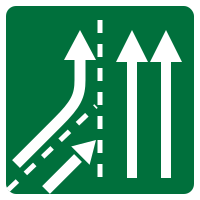
Traffic merging from the left
Traffic from the slip road joins your carriageway and must give way. If you are in the left lane you keep your lane, but leave room and move right only if it is safe and helpful. In the next lane, expect company and leave a gap.
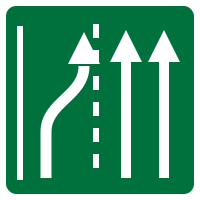
Left-hand lane closed ahead
The left lane simply ends. Nothing is joining. Move right early rather than driving to the very end of the lane.
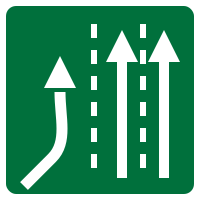
Lane gained on the left
The slip road becomes a full extra lane. Nobody has to merge, so stay where you are and let joining traffic settle.
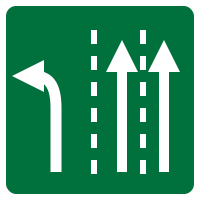
Lane arrangement ahead
Shows which lane leads where at the junction ahead. Pick your lane early instead of swerving across at the last second.
The one distinction that matters: if the arrow for your lane bends, you are the one who has to move. If it stays straight, hold your lane and let the joining traffic sort itself out. Everything else on the sign is context.
Joining from a Slip Road
This is the part that worries most learners. The slip road exists to let you reach the speed of the traffic you are joining. Use all of it.
- 1
Build speed on the slip road
Accelerate firmly. You are aiming to arrive at the main carriageway travelling at roughly the same speed as the traffic already on it.
- 2
Look right early
Start glancing right while you are still building speed, so you already know where the gaps are before you run out of slip road.
- 3
Pick your gap
Choose a real gap and commit to it. Two car lengths at 60mph is not a gap. Aim to arrive alongside a space, not alongside a car.
- 4
Mirror, signal, blind spot
Right mirror, right signal, then a blind spot check over your right shoulder before you move.
- 5
Merge smoothly
Move across in one steady line. No swerving, no drifting back out again.
- 6
Cancel and settle
Cancel the signal, adjust to match the traffic, and open up a proper following gap.
Do not stop at the end
Stopping at the end of a slip road leaves you trying to pull out from a standstill into traffic at speed, with a queue building behind you. Only stop if the traffic is genuinely stationary and there is no other option.
Priority sits with them
Traffic already on the carriageway has priority. Most drivers will move over or ease off to help you in, but you cannot rely on it. Adjust your speed to fit the gap rather than expecting the gap to adjust to you.
Lane Discipline
- Keep left. The left lane is the normal driving lane. On a two-lane dual carriageway the right lane is for overtaking or turning right, not for cruising.
- Return after overtaking. Move back left once you are safely past and can see the vehicle in your mirror.
- Do not overtake on the left. The exception is queuing traffic where your lane happens to be moving faster than the one on your right.
- Watch for lorries. Vehicles restricted to lower speeds will be in the left lane, so plan your overtakes around them rather than arriving behind one at speed.
- Position for the exit. If your turning is coming up, be in the left lane well before the countdown starts.
Overtaking Safely
- Mirrors first, always. Something approaching at 70mph closes far quicker than you expect.
- Blind spot check. Every single time before you change lane. No exceptions.
- Signal in good time. Give following traffic the chance to react before you move.
- Commit to the manoeuvre. Pull out decisively, pass, and return. Hesitating alongside another vehicle is where trouble starts.
- Do not sit in blind spots. Either be clearly behind or clearly past.
Speed limits: the national speed limit on a dual carriageway is 70mph for cars, and 60mph if you are towing a trailer or caravan. Lower limits apply where signed, and many urban dual carriageways in London are signed at 40 or 50.
Leaving at the Exit
Get left early
Be in the left lane in good time. Cutting across at the last moment is dangerous and marks you down on test.
Signal, then slow
Signal left as you approach, then do your braking on the slip road, not on the main carriageway where traffic is still at speed behind you.
Check your speed
After a long spell at 70mph, 30mph feels like walking pace. Look at the speedometer rather than trusting the feeling, especially on a roundabout at the top of the slip road.
Where It Usually Goes Wrong
Joining too slowly
Arriving at 40mph into traffic doing 70 forces everyone else to react to you. Use the slip road to get up to speed.
Stopping at the slip road end
Turns an easy merge into a standing start across live traffic.
Middle lane cruising
Staying out when the left lane is clear. It blocks other traffic and gets marked as a fault.
Mirrors without blind spot checks
The mirror will not show you the car sitting just off your rear quarter.
Reacting to the sign too late
Seeing the merge sign and moving over at the last second instead of planning across the next few hundred yards.
Carrying the speed off
Braking on the carriageway instead of the slip road, or arriving at the roundabout still doing 50.
Key Takeaways
Bent Arrow Means You Move
On a lane arrangement sign, only the lane whose arrow curves has to change lane. A straight arrow means hold your position.
Match the Speed, Then Merge
The slip road is there to let you reach the speed of the traffic. Arriving too slowly is the most common joining fault.
Look Further, Decide Sooner
Everything you already do in town still applies. It just needs to happen several seconds earlier.
The Left Lane Is Home
Overtake in the right-hand lanes, then come back. Do not settle in the middle.
Keep Going
Dual carriageways are one of those skills that only really click with an instructor beside you on a road like the A12 or the A406.