The DVSA lists three reversing exercises for your practical driving test (bay parking can be done forwards or in reverse, which is why there are four clips), and the examiner will pick one. You may also be asked to carry out a controlled stop, sometimes called the emergency stop. Below is a step by step animated guide to each one, showing the method, the reference points to look for, and what should appear in your mirrors.
These guides are here to help the method click between lessons. They do not replace practice with a qualified instructor in a real car, on real roads, where every car park and kerb is a little different.
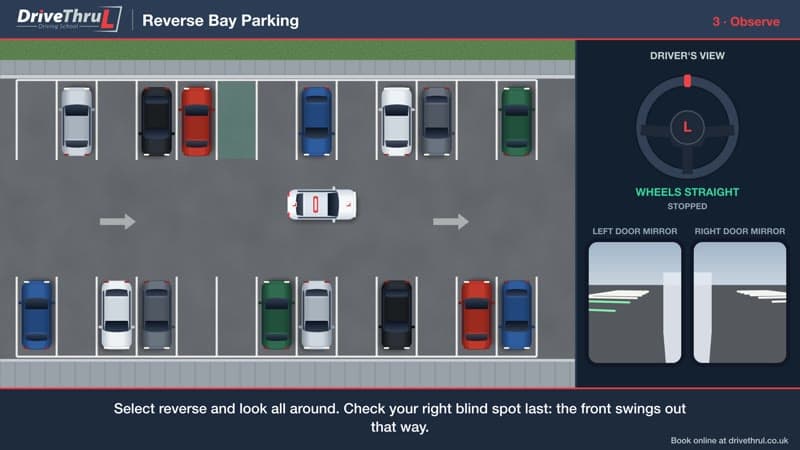
1. Reverse bay parking
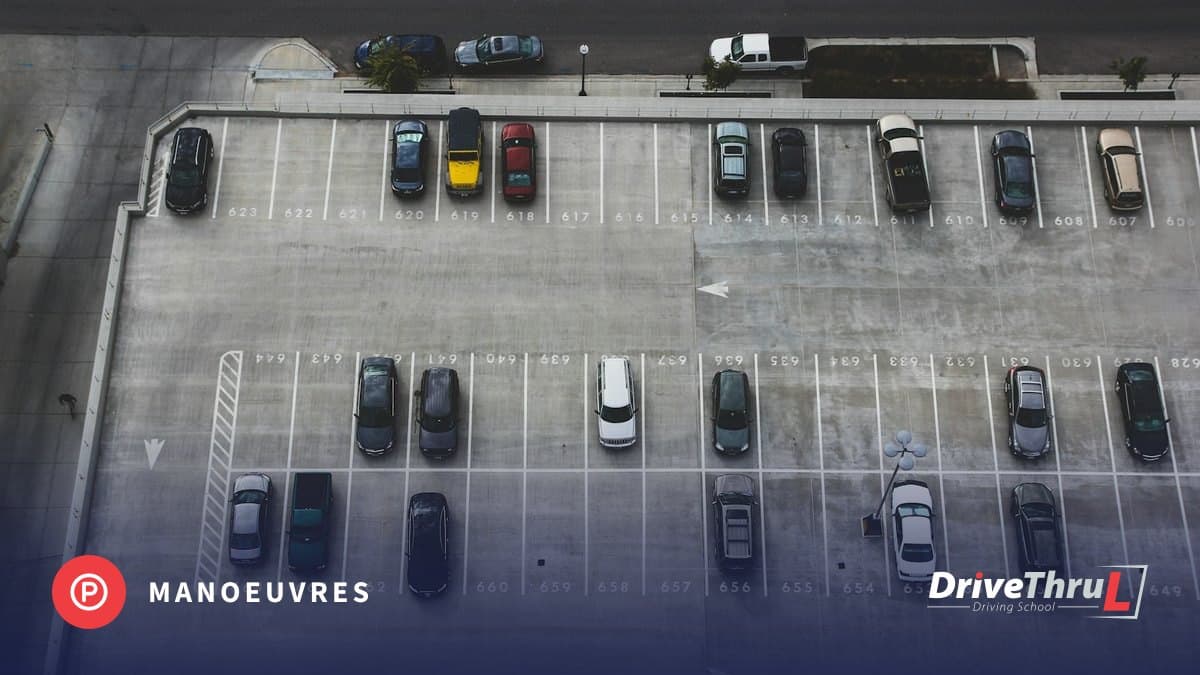
Reversing into a parking bay, usually at a test centre car park. The aim is to finish reasonably central within the bay, between the white lines.
- Position. Sit roughly centred in the aisle with the bays on your left, and select reverse so your reversing light shows your intention.
- Reference point. When a bay line lines up with the centre of your passenger door, check your right blind spot, then reverse slowly and steer full lock to the left. Reference points shift with the car you drive, so use the one your instructor sets for you rather than a number from a video.
- Mirror check. As the car turns, line A appears in your left mirror, then line B in your right. Use them to judge your angle and distance.
- Straighten and finish. When both lines look parallel, straighten up and reverse back until central and far enough in. Secure the car and take a final all round check.
2. Parallel parking
Reversing into a space behind a parked car at the side of the road, finishing parallel and close to the kerb, within about two car lengths.
- Position. Pull up alongside the parked car, about a door's width out, with your rear bumpers roughly level, then select reverse.
- Turn point. When your rear bumper is level with the back of the parked car, reverse slowly and steer full lock to the left.
- Forty-five degrees. Bring the car back to about forty-five degrees, watching your nearside mirror for the kerb. Keep well clear of the parked car.
- Straighten in. As the kerb appears, steer to the right to bring the front in, then straighten the wheels so you finish parallel and close to the kerb.
For every reference point in detail, plus how to recover when you end up too far from the kerb, see the full parallel parking guide.
3. Forward bay parking
Driving forward into a bay, then reversing out again. This one is done in a public car park on the test route rather than at the test centre, and reversing back out is part of the exercise.
- Position. Approach slowly and keep wide of the bay you want, so you have room to swing the front in.
- Point of turn. As the far line of your target bay reaches your door mirror, steer full lock and drive slowly forward into the bay.
- Finish in the bay. Straighten the wheels as the car comes into line, keeping it central between both white lines, then secure the car.
- Leaving. To leave, select reverse and check all around for traffic and pedestrians, then reverse out slowly and straighten only when it is clear.
Both directions are covered step by step in the full bay parking guide.
4. Pull up on the right
Pulling up on the right hand side of the road, reversing back about two car lengths, then moving off again. This is the only manoeuvre carried out on the wrong side of the road, so observation is everything.
- Pull up on the right. Check your mirrors, signal right, and give way to anything coming towards you. When it is safe, cross over and stop close and parallel to the right hand kerb. Do not choose a spot opposite a junction or a parked car.
- Secure and observe. Secure the car and take a full all round observation, including over both shoulders, before you move.
- Reverse two car lengths. Reverse back about two car lengths, staying close to the kerb and looking mainly through your rear window.
- Move off. When it is clear, signal and move off, returning to the correct, left hand side of the road as soon as it is safe.
5. The controlled (emergency) stop
The examiner asks for this on roughly one test in seven, so you should be ready for it. The signal is explained to you beforehand. The aim is to stop the car promptly and safely, in a straight line, under full control.
- Driving on. Drive normally with both hands on the wheel, looking well ahead and ready to react.
- React. On the signal, react promptly. In a real emergency there is no time to check your mirror first.
- Brake firmly. Brake firmly and progressively, keeping the car straight. In a manual, press the clutch down just before you stop so the engine does not stall. In an automatic there is no clutch, so simply brake and hold the car still.
- Secure and move off. Once stopped, secure the car. To move off again, take a full all round observation, as traffic may have caught up behind you.
The emergency stop guide covers stopping distances and what the examiner marks.
Practising for real
Watching the method is the easy part. Getting it smooth and consistent takes practice with someone who can see what you cannot, and who can read each new car park and road for you. Each manoeuvre also has its own practice page with steps, common mistakes and FAQs: start at driving test manoeuvres. If you would like lessons with a local, DVSA-qualified instructor in East London, you can book lessons here.